Culture
Bridging Taiwanese Art with the World
Our support for contemporary art is not about collection-building or short-term sponsorship.
It carries a spirit closer to venture investment—aiming to make the overall ecosystem healthier and more complete.
Duration:2008~2023
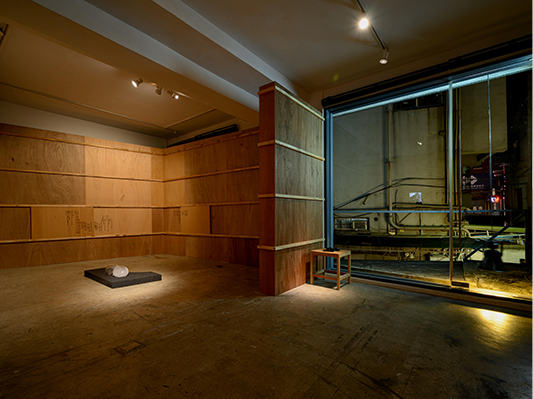
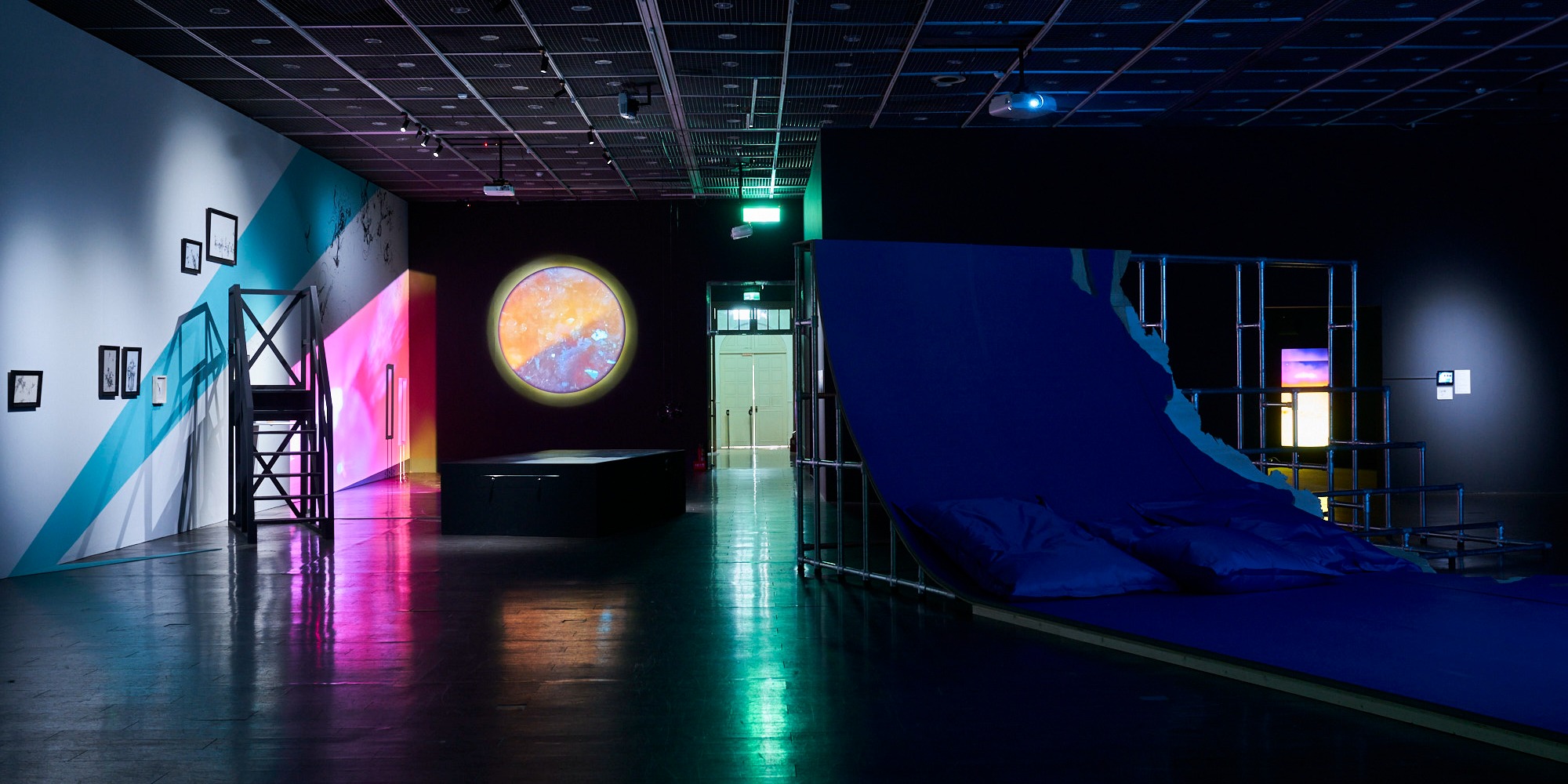
《諧波失真-陳庭榕個展》,於立方計劃空間,2021(王世邦攝,立方計劃空間提供)
Rationale
To make contemporary art more widely seen, artists are not the only key players—curators are, in fact, crucial.
A curator’s role goes far beyond simply displaying artworks. Curators research themes, frame perspectives, design the structure of an exhibition, and ultimately decide what an exhibition is “saying to the world.”
In Taiwan, many major museums are primarily public institutions and, by design, tend to avoid engagement with commercial resources. As a result, there remains significant room for collaboration among the private sector, government, and academia throughout the development of the arts.
Compared with international expectations—where curators are often required to demonstrate global vision, deep research capability, and strong, coherent narratives—Taiwanese curators who aim to step onto the international stage need more resources. They must build a stronger understanding of global art trends in order to propose curatorial projects with clear viewpoints and a wider worldview, and to bring Taiwanese artists with them to reach beyond Taiwan.
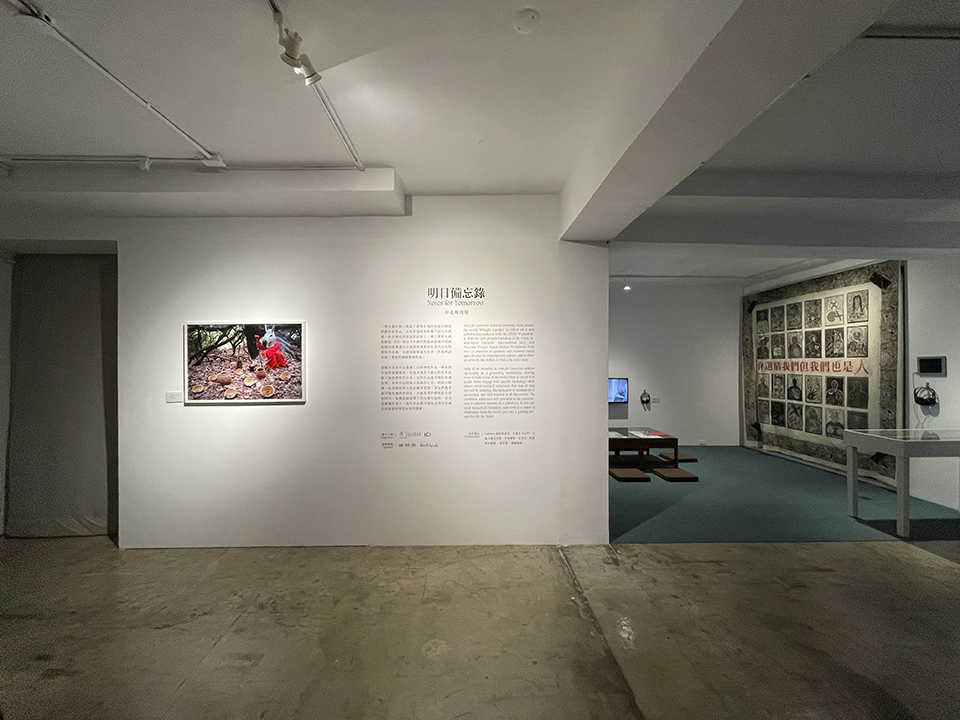
「明日備忘錄」國際巡迴展—台北城南版,於立方計劃空間,2022(立方計劃空間提供)
Initiatives
RC’s first initiative supporting contemporary visual art was to help IT Park (Yitong Park), an alternative-space-driven institution, build a comprehensive English-language website.
This website was not limited to introducing exhibitions or artists. It also included English translations and editorial organization of critical writings and background materials—making it easier for international curators and art professionals to understand what kinds of artistic practices are taking place in Taiwan. In a sense, it functioned like an English-language database of Taiwanese artists, offering very practical support in increasing international visibility.
RC then went on to support the Cube Project Space, founded by curators. This space serves as an experimental platform centered on contemporary art, integrating humanistic inquiry and historical context while actively connecting international and local art networks.
Its goal is clear: leveraging curators with established international experience and visibility to introduce Taiwanese art to the world, while also nurturing a younger generation of curators so that experience and global perspective can be carried forward.
For us, loving art is not only about visiting exhibitions or collecting works—what matters more is this:
How can Taiwanese artists be truly understood and seen internationally?
Impact
From 2012 onward, we also supported the operations of the Taipei Contemporary Art Center (TCAC). TCAC matters because it functions as a “convergence point of energy.”
Unlike the top-down operations of traditional museums, TCAC enables artists to self-organize into teams, propose projects, and create freely. Artists can speak, experiment, and realize their ideas here.
In terms of international exchange, TCAC has continually invited artists and curators from abroad to Taiwan, becoming an important node connecting international non-profit art spaces.
Our support for contemporary art is not about collection-building or short-term sponsorship. It carries a spirit closer to venture investment—aiming to make the overall ecosystem healthier and more complete. Step by step, we invest in the full chain: artists’ creation, curators’ research and exhibition-making, and platforms capable of engaging in global dialogue.
We look forward to a day when Taiwanese contemporary art is not only something that “people are doing,” but something that can truly be seen, understood, and remembered on the international stage.
From 2012 onward, we also supported the operations of the Taipei Contemporary Art Center (TCAC). TCAC matters because it functions as a “convergence point of energy.”
Unlike the top-down operations of traditional museums, TCAC enables artists to self-organize into teams, propose projects, and create freely. Artists can speak, experiment, and realize their ideas here.
In terms of international exchange, TCAC has continually invited artists and curators from abroad to Taiwan, becoming an important node connecting international non-profit art spaces.
Our support for contemporary art is not about collection-building or short-term sponsorship. It carries a spirit closer to venture investment—aiming to make the overall ecosystem healthier and more complete. Step by step, we invest in the full chain: artists’ creation, curators’ research and exhibition-making, and platforms capable of engaging in global dialogue.
We look forward to a day when Taiwanese contemporary art is not only something that “people are doing,” but something that can truly be seen, understood, and remembered on the international stage.