Knowledge
A Rose by Any Other Name Would Smell As Sweet

Whether it is a company, a social enterprise, an NPO, or even a social movement,
we ultimately care about just two questions:Does this model truly work?
And when you designed it, did you genuinely believe in it?
Duration:2014~2018
Rationale
In the world of public-good initiatives, there are long-established nonprofit organizations (NPOs/NGOs),
as well as the more recently prominent social enterprises.
Each model has its own value and role.
So which one should we choose?
There is a popular joke online that captures it well:
“Only children feel the need to choose—adults take both.”
We see public good in the same way.
It is not about choosing one over the other, but about selecting the most suitable approach for each specific problem.
Extending our ongoing interest in new media, as a foundation we also care deeply about how public-good initiatives are communicated and understood.
Although topics like CSR, social enterprises, and NPOs are often discussed,
they still remain somewhat distant from mainstream attention—and are rarely considered “attention-grabbing.”
That is why we place strong emphasis on supporting knowledge platforms that can continuously document, report, and research public-good efforts.
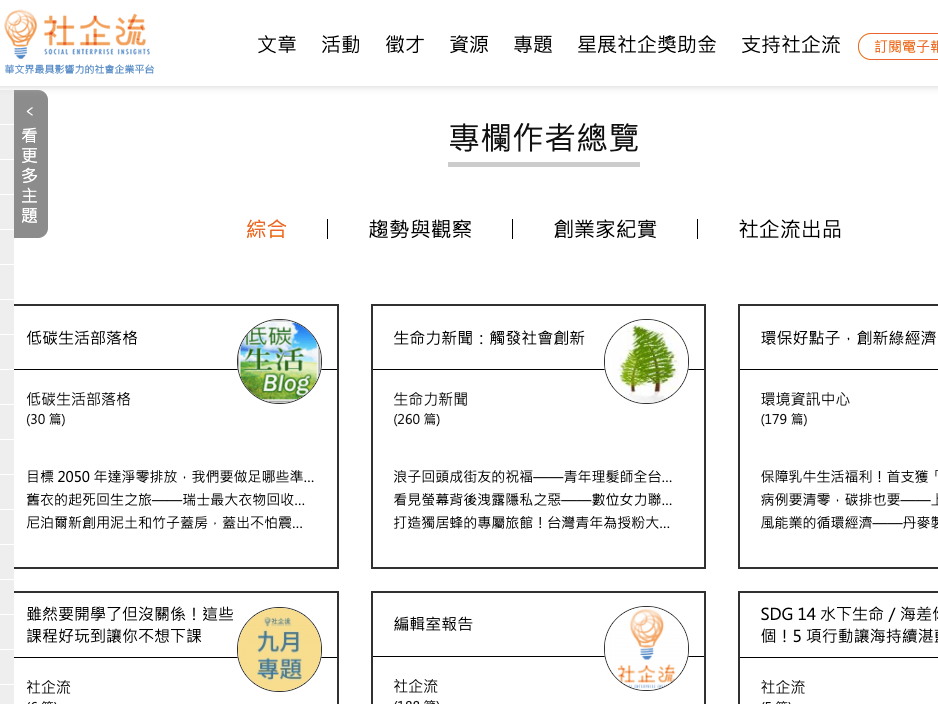
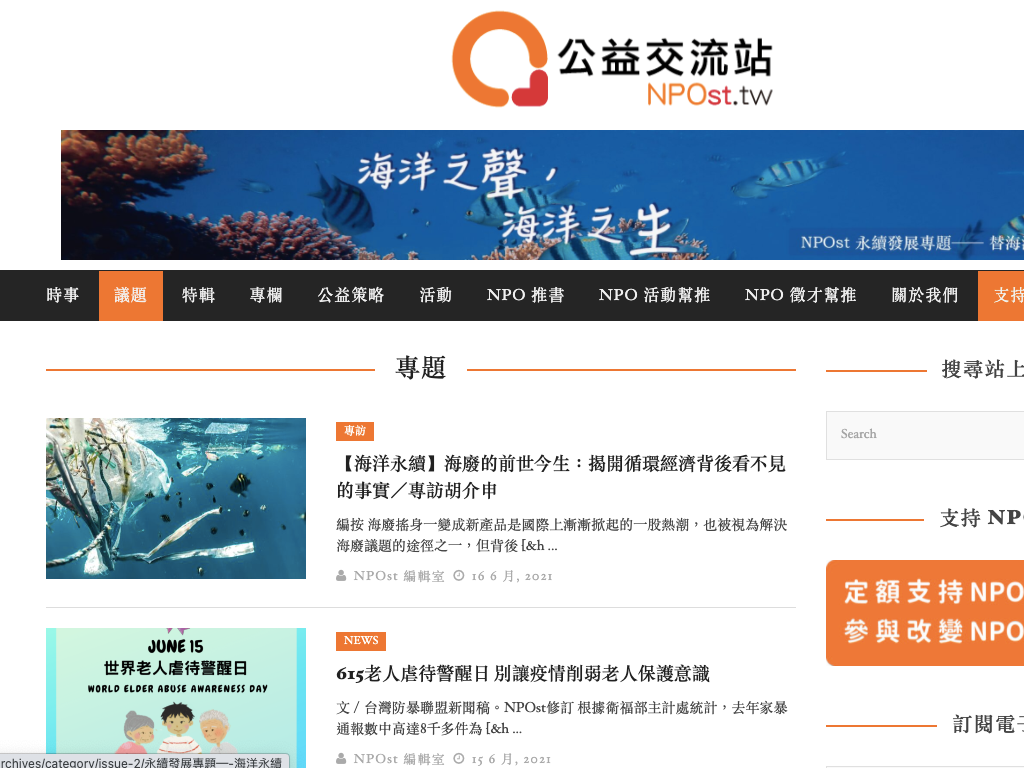
Within this thinking, Social Enterprise Insights (SEI) and NPOst became important partners.
Initiatives
Social Enterprise Insights (SEI) aims to build the most comprehensive Chinese-language platform for social enterprises and social innovation,
collecting and sharing experiences of solving social problems through business approaches, and helping to shape an ecosystem for social innovation.
NPOst, on the other hand, is a media platform dedicated to nonprofit organizations—
making the professional value of NPOs more visible, while expanding the perspectives of those working in the sector.
Supporting both platforms reflects a core belief of ours:
Public good requires multiple models, not a single answer.
We believe in the idea of social enterprises—
that social progress can be driven through consumption and transactions.
At the same time, we remind ourselves that donation itself carries irreplaceable value.
If one day people come to believe that only transactional forms of public good are valid,
would that not turn goodwill into another kind of pressure?
Taken further—perhaps even uncomfortably—
would taxation then be reduced to nothing more than an unavoidable form of state coercion?
For this reason, we remain cautious of any notion that public good should be reduced to a single “preferred” model.
During our collaboration with SEI and NPOst, we also noticed another pattern:
most platforms tend to highlight success stories and inspiring visions.
But in reality, failure is just as important.
So we also chose to support Fuckup Nights—
a global community dedicated to sharing stories of failure.
Because what we learn from failure is often more honest, and ultimately more useful, than what we learn from success.
Impact
Viewed through a broader historical lens,
from the East India Company in the Age of Exploration to today’s multinational corporations in a globalized world,
the role of organizations has always been evolving.
That is why, when choosing whom to support, we have never been overly concerned with what an organization “looks like.”
Whether it is a company, a social enterprise, an NPO, or even a social movement, we always return to two fundamental questions:
Does this model truly work?
And did you genuinely believe in it when you created it?
As long as the answer is yes, form has never been the issue.
Viewed through a broader historical lens,
from the East India Company in the Age of Exploration to today’s multinational corporations in a globalized world,
the role of organizations has always been evolving.
That is why, when choosing whom to support, we have never been overly concerned with what an organization “looks like.”
Whether it is a company, a social enterprise, an NPO, or even a social movement, we always return to two fundamental questions:
Does this model truly work?
And did you genuinely believe in it when you created it?
As long as the answer is yes, form has never been the issue.